Jul 1, 2021

Монасите Касиан и Огнян от Копиловския манастир

„Смирението, вярата и любовта към врага са най-великите сили на този свят“ - казва отец Касиан. Опасява, че на фона на други по-агресивни и нечовеколюбиви религии, православието е уязвимо. Но вярата и пълното упование в Бога, който изпраща чудеса, ще ни помогнат да оцелеем, убеден е игуменът на Копиловския манастир. Истинско чудо е и пристигането на послушник Огнян в манастира, където младият мъж намира спасение на душата си след дългогодишно пребиваване в САЩ. Автор: Венета Николова, режисьор : Николай Василев, оператор:Борислав Георгиев. Филмче от поредицата "Малки истории" на БНТ . Още на : Още на  http://pateshestvia.net/


Манастирът е основан през 2003 г. Изграждан е със средства от селско и рибно стопанство и дарения. Обработва стотици декари земи, има и стопанство с животни, рибарник и пчелини.   

Подчинен е на Българската старостилна православна църква до 2005 г. Подведомствен е на Църквата на истинноправославните християни в Гърция от 2009 г. до 14 октомври 2018 г.
Преминава към Българската православна църква през 2020 г.

Discussion: Yoga and Orthodox Christianity


From Nikolay Nikolov: "На Света гора срещнах Владимир от Москва. След тежък инцидент той срещнал Бог лице в лице.
Предавам малка част от разказа му:
- Бог ми показа и ада. Имаше едно място с милиони хора, като черни силуети и със затворени очи, стоящи прави в безкрайни редици. Те бяха будисти, йоги и т.н. Всеки един от тях чувстваше  вечна самота, студ и мрак. Малкото утешение което получаваха бе  чрез  молитвите на  християните на земята, молещи се за всички починали хора. Тогава очите им леко се отваряха и виждаха, че пред тях има друг човек, че не са сами."

Мистичното Православие: исихазма

From Army Media BG: 

"В настоящето предаване от поредицата „Знаците” ще ви разкрием основите на исихазма – мистично разклонение на православната вяра. Като най-висша форма на монашеското уединение, неговата цел е постигане на духовно съвършенство и единство с Бога. Исихазмът не е за всеки монах, уточнява пред камерата ни игуменът на Църногорския манастир „Св. св. безсребърници и чудотворци Козма и Дамян” – йеромонах Никанор. Какво, обаче, отличава мистичната традиция от монашеското уединение и защо исихазмът е определян за велика тайна?  Влязохме в Богословския факултет на Софийския университет, за да се срещнем с доц. Костадин Нушев. Той ни разказа за традицията на исихазма и нейното възобновяване през вековете. От него научаваме защо патриарх Евтимий Търновски е станал исихастки сподвижник и ролята на България в разпространението на исихазма. Една от тайните на духовната практика е постигането на „умна молитва”, която в своето съвършенство исихастът използва насън."


Part 2: https://www.youtube.com/watch?v=9mAAsKbmNgQ

Jun 12, 2021

What is truth?

 What is truth asked Pilate and didn’t wait for the answer. The reply was already given before that by Jesus Christ who said I am the way, the truth and the life. 

The real question is not what is truth but who is truth as per the discussion at the end of the podcast here:

https://podcasts.google.com/?feed=aHR0cHM6Ly9mZWVkcy5hbmNpZW50ZmFpdGguY29tL0RhaWx5T3J0aG9kb3hTY3JpcHR1cmVz&episode=aHR0cHM6Ly93d3cuYW5jaWVudGZhaXRoLmNvbS9wb2RjYXN0cy9kYWlseXNjcmlwdHVyZXMvanVuZV8xMF8yMDIxIzQ4MzI4

Oct 10, 2010

Gospel Reading - October Calendar

The reading is from John 20:19-31

On the evening of that day, the first day of the week, the doors being shut where the disciples were for fear of the Jews, Jesus came and stood among them and said to them: "Peace be with you." When He had said this, He showed them His hands and His side.

"If you forgive the sins of any, they are forgiven; if you retain the sins of any, they are retained."

Feb 15, 2010

Bible Reading: February 15

The Reading is from Proverbs 1:1-20

The proverbs of Solomon, son of David, king of Israel:

The fear of the Lord is the beginning of knowledge; fools despise wisdom and instruction.

References:
GOARCH

Feb 4, 2010

Venerable St. Isidore of Pelusium

February 4: St. Isidore of Pelusium.

Father Isidore of Pelusium was a monastic in the deserts of Egypt, making Mount Pelusium his home. He died about the year 436.

Isidore was Egyptian by birth and from a prominent Alexandrian family, which included Alexandrian Patriarchs Theophilus and Cyril.

He studied all the secular disciplines, but as a youth withdrew from the world, renouncing his riches and earthly glory, so that he might devote himself entirely to the spiritual life. For a short time he taught rhetoric in Pelusium in Egypt.

After a year of ascetical life, he returned to Pelusium, where he was ordained to the priesthood. After a few years he retired to a monastery where he spent the rest of his life, eventually becoming abbot. From the monastery he wrote thousands of epistles full of divine grace and wisdom; of these more than 2,000 still survive.

He wrote more than 10,000 letters to numerous individuals, giving reproach, counsel, encouragement, comfort, and instruction.

At the time of the persecution of St. John Chrysostom, Archbishop of Constantinople, the populace was split into two factions, one for Chrysostom and the other against. Abba Isidore sided with the golden-tongued saint.

Quotes from his letters

"It is more important to teach by a life of doing good than to preach in eloquent terms."

"If one desires that his virtues appear great, let him consider them small, and they will surely manifest themselves as great."

"To live without speaking is better than to speak without living. For the former who lives rightly does good even by his silence, but the latter does no good even when he speaks. When words and life correspond to one another they are together the whole of divine philosophy."

References:
Isidore of Pelusium. OrthodoxWiki.

Jan 31, 2010

St. Cyrus and John, the Unmercenaries

These Saints lived during the years of Diocletian. Saint Cyrus was from Alexandria, and Saint John was from Edessa of Mesopotamia.

Because of the persecution of that time, Cyrus fled to the Gulf of Arabia, where there was a small community of monks. John, who was a soldier, heard of Cyrus' fame and came to join him. Henceforth, they passed their life healing every illness and disease freely by the grace of Christ; hence their title of "Unmercenaries."

References:
Cyrus and John the Unmercenaries — Greek Orthodox Archdiocese of America.
Cyrus and John - Wikipedia, the free encyclopedia.

Bible Reading: January 31

Gospel: The Reading is from Matthew 28:16-20.

The eleven disciples went to Galilee, to the mountain to which Jesus had directed them. And Jesus came and said to them, "All authority in heaven and on earth has been given to me. Go therefore and make disciples of all nations, baptizing them in the name of the Father and of the Son and of the Holy Spirit, teaching them to observe all that I have commanded you; and lo, I am with you always, to the close of the age. Amen."

Gospel: Sunday of Prodigal Son - The Reading is from Luke 15:11-32.

References:
GOARCH.org.

Jan 28, 2010

St. Ephrem the Syrian

Ephrem the Syrian was a Syriac deacon and a prolific Syriac-language hymnographer and theologian of the 4th century. He is venerated by Christians throughout the world, and especially among Syriac Christians, as a saint.

Ephrem wrote a wide variety of hymns, poems, and sermons in verse, as well as prose biblical exegesis. These were works of practical theology for the edification of the church in troubled times. So popular were his works, that, for centuries after his death, Christian authors wrote hundreds of pseudepigraphous works in his name. He has been called the most significant of all of the fathers of the Syriac-speaking church tradition.


Icon of St. Ephrem. Image source: Wikipedia, public domain.

Ephrem was born around the year 306 in the city of Nisibis (the modern Turkish town of Nusaybin, on the border with Syria, which had come into Roman hands only in 298).

He was ordained as a deacon either at his baptism or later. He began to compose hymns and write biblical commentaries as part of his educational office.

Ephrem comments that orthodox Nicene Christians were simply called 'Palutians' in Edessa, after a former bishop. Arians, Marcionites, Manichees, Bardaisanites and various Gnostic sects proclaimed themselves as the true church. In this confusion, Ephrem wrote a great number of hymns defending Nicene orthodoxy.

After a ten-year residency in Edessa, in his sixties, Ephrem succumbed to the plague as he ministered to its victims. The most reliable date for his death is 9 June 373.

Over 400 hymns composed by Ephrem still exist. Granted that some have been lost, Ephrem's productivity is not in doubt. The church historian Sozomen credits Ephrem with having written over three million lines. Ephrem combines in his writing a threefold heritage: he draws on the models and methods of early Rabbinic Judaism, he engages skillfully with Greek science and philosophy, and he delights in the Mesopotamian/Persian tradition of mystery symbolism.

The most important of his works are his lyric, teaching hymns. These hymns are full of rich, poetic imagery drawn from biblical sources, folk tradition, and other religions and philosophies. The madrāšê are written in stanzas of syllabic verse, and employ over fifty different metrical schemes.

Ephrem also wrote verse homilies. These sermons in poetry are far fewer in number than the madrāšê.

The third category of Ephrem's writings is his prose work. He wrote biblical commentaries on the Diatessaron (the single gospel harmony of the early Syriac church), on Genesis and Exodus, and on the Acts of the Apostles and Pauline Epistles.

Ephrem wrote exclusively in the Syriac language, but translations of his writings exist in Armenian, Coptic, Georgian, Greek and other languages. Some of his works are only extant in translation (particularly in Armenian). Syriac churches still use many of Ephrem's hymns as part of the annual cycle of worship.

A legend attached to Ephrem is that he was a monk. In Ephrem's day, monasticism was in its infancy in Egypt. He seems to have been a part of the members of the covenant, a close-knit, urban community of Christians that had 'covenanted' themselves to service. Later hagiographers often painted a picture of Ephrem as an extreme ascetic, but the internal evidence of his authentic writings show him to have had a very active role, both within his church community and through witness to those outside of it.

The most popular title for Ephrem is Harp of the Spirit. He is also referred to as the Deacon of Edessa, the Sun of the Syrians and a Pillar of the Church.

Today, Saint Ephrem presents an engaging model of Asian Christianity. Ephrem also shows that poetry is not only a valid vehicle for theology, but is in many ways superior to philosophical discourse for the purpose of doing theology.

Ephrem displays a deep sense of the interconnectedness of all created things, which could develop his role in the church into that of a 'saint of ecology'. Other studies have focused on the importance of 'healing' imagery in Ephrem.

References:
GOARCH.org.
Ephrem the Syrian
Ephrem the Syrian, from Wikipedia, the free encyclopedia.

Related:

Bible Reading: January 28

Gospel: The Reading is from Luke 6:17-23

At that time, Jesus stood on a level place, with a great crowd of his disciples and a great multitude of people who came to hear him and to be healed of their diseases.

And all the crowd sought to touch him, for power came forth from him and healed them all.

And he lifted up his eyes on His disciples, and said: "Blessed are you poor, for yours is the Kingdom of God. Blessed are you that hunger now, for you shall be satisfied. Blessed are you that weep now, for you shall laugh. Blessed are you when men hate you, and when they exclude you and revile you, and cast out your name as evil, on account of the Son of man! Rejoice in that day, and leap for joy, for behold, your reward is great in heaven."

Epistle: The Reading is from St. Paul's Letter to the Galatians 5:22-26; 6:1-2

Brethren, the fruit of the Spirit is love, joy, peace, patience, kindness, goodness, faithfulness, gentleness, self-control; against such there is no law.

And those who belong to Christ Jesus have crucified the flesh with its passions and desires. If we live by the Spirit, let us also walk by the Spirit.

Let us have no self-conceit, no provoking of one another, no envy of one another.

Brethren, if a man is overtaken in any trespass, you who are spiritual should restore him in a spirit of gentleness. Look to yourself, lest you too be tempted. Bear one another's burdens, and so fulfill the law of Christ.

References:
GOARCH.org.

Jan 26, 2010

Parable of the Prodigal Son

January 26.

The Prodigal Son, also known as the Lost Son, is one of the best known parables of Jesus. It appears only in the Gospel of Luke in the New Testament of the Bible. By tradition, it is usually read on the third Sunday of Lent. It is the third and final member of a trilogy, following the Parable of the Lost Sheep and the Parable of the Lost Coin.


Rembrandt, Return of the Prodigal Son, 1662, (Hermitage Museum, St Petersburg). Image source: Wikipedia, public domain.

The story is found in Luke 15:11-32.

Jesus tells the story of a man who has two sons. The younger demands his share of his inheritance while his father is still living, and goes off to a distant country where he "waste[s] his substance with riotous living" and eventually has to take work as a swineherd (clearly a low point, as swine are unclean in Judaism).

There he comes to his senses and decides to return home and throw himself on his father's mercy, thinking that even if his father does disown him, being one of his servants is still far better than feeding pigs.

But when he returns home, his father greets him with open arms and hardly gives him a chance to express his repentance. He kills a fatted calf to celebrate his return.

The older brother resents the favored treatment of his faithless brother and complains of the lack of reward for his own faithfulness. But the father responds: " 'My son,' the father said, 'you are always with me, and everything I have is yours. But we had to celebrate and be glad, because this brother of yours was dead and is alive again; he was lost and is found.'

The Eastern Orthodox Church traditionally reads this story on the Sunday of the Prodigal Son, which in their liturgical year is the Sunday before Meatfare Sunday and about two weeks before the beginning of Great Lent.

References:
Parable of the Prodigal Son. From Wikipedia, the free encyclopedia.

Related:

Bible Reading: January 26

Gospel: Tuesday of Prodigal Son, The Reading is from Mark 13:14-23

The Lord said to his disciples, And then if any one says to you, 'Look, here is the Christ!' or 'Look, there he is!' do not believe it. False Christs and false prophets will arise and show signs and wonders, to lead astray, if possible, the elect. But take heed; I have told you all things beforehand."

References:
GOARCH.org.

St. Xenophon & his Companions

St. Xenophon was a wealthy nobleman of Constantinople who had two sons, Arcadius and John, whom he sent to Beirut to study law. When they were shipwrecked during their voyage; they forsook all things and departed for Palestine.

Saint Xenophon and his wife Mary, ignorant of what had happened, went in search of their sons. On finding them in Jerusalem, dressed in the habit of monks, they also took up the monastic life.

And thus, having completed their lives in holiness, they departed for the Lord about the beginning of the sixth century. Saint Xenophon and his sons reposed at Saint Sabbas Monastery, and Mary at the Monastery of Saint Theodosius.

References:
Xenophon & his Companions — Greek Orthodox Archdiocese of America

Jan 25, 2010

St. Gregory the Theologian, Archbishop of Constantinople

Gregory the Theologian, also known as Gregory of Nazianzus (though that name more appropriately refers to his father) and Gregory the Younger, was a great Father and Teacher of the Church.

With Sts. Basil the Great and John Chrysostom, he is numbered among the Three Holy Hierarchs whose feast day is celebrated on January 30. St. Gregory is also known as one of the Cappadocian Fathers.

He was born in 329 in Arianzus, a village of the second district of Cappadocia, not far from Nazianzus. His father, who later became Bishop of Nazianzus, was named Gregory (commemorated Jan. 1), and his mother was named Nonna (Aug. 5); both are among the saints, and so are his brother Caesarius (Mar. 9) and his sister Gorgonia (Feb. 23).

At first he studied in Caesarea of Palestine, then in Alexandria, and finally in Athens. As he was sailing from Alexandria to Athens, a violent sea storm put in peril not only his life but also his salvation, since he had not yet been baptized. With tears and fervour he besought God to spare him, vowing to dedicate his whole self to Him, and the tempest gave way to calm.

At Athens Saint Gregory was later joined by St. Basil the Great. Another fellow student of theirs in Athens was the young Prince Julian, who later as Emperor was called the Apostate because he denied Christ and did all in his power to restore paganism. Even in Athens, before Julian had thrown off the mask of piety; St. Gregory saw what an unsettled mind he had, and said, "What an evil the Roman State is nourishing" (Orat. V, 24, PG 35:693).

After their studies at Athens, Gregory became Basil's fellow ascetic, living the monastic life together with him for a time in the hermitages of Pontus. His father ordained him presbyter of the Church of Nazianzus.

About the year 379, Saint Gregory came to the assistance of the Church of Constantinople, which had already been troubled for forty years by the Arians; by his supremely wise words and many labours he freed it from the corruption of heresy, and was elected Archbishop of that city by the Second Ecumenical Council, which assembled there in 381, and condemned Macedonius, Archbishop of Constantinople, as the enemy of the Holy Spirit.

When St. Gregory came to Constantinople, the Arians had taken all the churches and he was forced to serve in a house chapel dedicated to St. Anastasia the Martyr. From there he began to preach his famous five sermons on the Trinity, called the Triadica.

When he left Constantinople two years later, the Arians did not have one church left to them in the city.


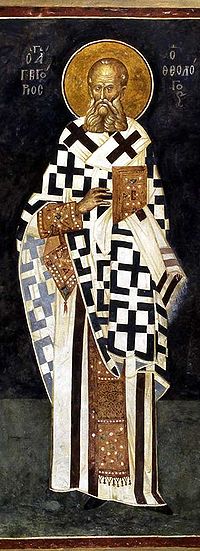
St. Gregory the Theologian. Image source: Wikipedia, public domain.

Having governed the Church until 382, he delivered his farewell speech—the Syntacterion, in which he demonstrated the Divinity of the Son—before 150 bishops and the Emperor Theodosius the Great; in this speech he requested, and received from all, permission to retire from the see of Constantinople. He returned to Nazianzus, where he lived to the end of his life, and reposed in the Lord in 391, having lived some sixty-two years.

His extant writings, both prose and poems in every type of metre, demonstrate his lofty eloquence and his wondrous breadth of learning. In the beauty of his writings, he is considered to have surpassed the Greek writers of antiquity, and because of his God-inspired theological thought, he received the surname "Theologian."

Although he is sometimes called Gregory of Nazianzus, this title belongs properly to his father; he himself is known by the Church only as Gregory the Theologian. He is especially called "Trinitarian Theologian," since in virtually every homily he refers to the Trinity.

He is widely considered the most accomplished rhetorical stylist of the patristic age. As a classically trained speaker and philosopher he infused Hellenism into the early church, establishing the paradigm of Byzantine theologians and church officials.


A Byzantine-style icon depicting the Three Holy Hierarchs: (left to right:) Basil the Great, John Chrysostom and Gregory the Theologian. Image source: Wikipedia, public domain.

References:
Gregory the Theologian - OrthodoxWiki
Gregory of Nazianzus - Wikipedia, the free encyclopedia
GOARCH.org.

Related:

Bible Reading: January 25

Gospel: The Reading is from John 10:9-16

The Lord said, "I am the door; if any one enters by me, he will be saved, and will go in and out and find pasture.

The thief comes only to steal and kill and destroy; I came that they may have life, and have it abundantly.

I am the good shepherd. The good shepherd lays down his life for the sheep. He who is a hireling and not a shepherd, whose own the sheep are not, sees the wolf coming and leaves the sheep and flees; and the wolf snatches them and scatters them. He flees because he is a hireling and cares nothing for the sheep.

I am the good shepherd; I know my own and my own know me, as the Father knows me and I know the Father; and I lay down my life for the sheep. And I have other sheep, that are not of this fold; I must bring them also, and they will heed my voice. So there shall be one flock, one shepherd."

References:
GOARCH.org.

Jan 24, 2010

St. Xenia of St. Petersburg, Fool-for-Christ

St. Xenia of Petersburg was born about the year 1730. She was married to a Colonel named Andrew; when she was 26 years old, her husband died suddenly, having been drinking with his friends. Xenia gave away all that she had, and vanished from Saint Petersburg for eight years; it is believed that she spent this time in a hermitage, learning the spiritual life.

When she returned to Saint Petersburg, she wore her husband's military clothing, and would answer only to the name Andrew, that is, the name of her late husband.

She took up the life of a homeless wanderer, and was abused by many as insane; she bore this with patience, praying for her husband's soul. She was given great gifts of prayer and prophecy, and often foretold things to come; in 1796 she foretold the death of Empress Catherine II.

Her grave became such a source of miracles, and so many came to take soil from it as a blessing, that it was often necessary to replace the soil; when a stone slab was placed over her grave, this too disappeared over time, piece by piece. Saint Xenia is especially invoked for help in finding employment, lodging, or a spouse.

References:
Xenia of St. Petersburg, Fool-for-Christ — Greek Orthodox Church.
Xenia of St. Petersburg - OrthodoxWiki.

Related:

St. Xenia, Deaconess Of Rome

Saint Xenia the Righteous of Rome was a saint of 5th century A.D.

Born with the name Eusebia to wealthy parents in Rome, she is said to have left Rome at the age of 17 to escape an unwelcome arranged marriage. She traveled to the island of Kos in the Aegean Sea, where she was given the name "Xenia" (stranger) and eventually became a deaconess revered for having the power to heal. There she completed her life in asceticism.


Xenia of Rome. Image source: Wikipedia, Georges Jansoone,  Creative Commons Attribution 3.0 Unported license.

The Feast of St. Xenia is celebrated in the Orthodox church on January 24, the day on which she died. She is said to have foreseen her own death.

References:
Xenia, Deaconess of Rome — Greek Orthodox Archdiocese of America
Saint Xenia the Righteous of Rome - Wikipedia, the free encyclopedia

Sunday of the Publican and Pharisee

The Sunday of the Publican and Pharisee begins the Lenten Triodion, the liturgical book used in the services of Great Lent.

It is the Sunday after the Sunday of Zacchaeus and Sunday before Sunday of the Prodigal Son. This is the pre-Lenten start of the Easter cycle of worship in the Orthodox Church.

The Parable of the Pharisee and the Publican is a parable told by Jesus in the gospel of Luke.

The focus this Sunday is on the Gospel of Luke 18:10-14, in which two men went to the Temple to pray. One was a Pharisee, an externally decent and righteous man of religion, and the other was a publican, a sinful tax-collector who was cheating the people.

Though the Pharisee was genuinely righteous under the Law, he boasted before God and was condemned. The publican, although he was truly sinful, begged for mercy, received it, and was justified by God.

From Luke 18:9-14, NIV: "To some who were confident of their own righteousness and looked down on everybody else, Jesus told this parable: "Two men went up to the temple to pray, one a Pharisee and the other a tax collector. The Pharisee stood up and prayed about himself: 'God, I thank you that I am not like other men—robbers, evildoers, adulterers—or even like this tax collector. I fast twice a week and give a tenth of all I get.' But the tax collector stood at a distance. He would not even look up to heaven, but beat his breast and said, 'God, have mercy on me, a sinner.' I tell you that this man, rather than the other, went home justified before God. For everyone who exalts himself will be humbled, and he who humbles himself will be exalted."

On this Sunday in the preparation for Great Lent, Orthodox Christians are to see that they have not the religious piety of the Pharisee, but the repentance of the publican. They are called to think about themselves, in the light of Christ's teaching, as they really are and to beg for mercy. For everyone who exalts himself will be humbled, and everyone who humbles himself will be exalted. (Luke 18:14).

References:
Pharisee and the Publican - Wikipedia, the free encyclopedia.
Sunday of the Publican and Pharisee - OrthodoxWiki.
Sunday of the Publican and Pharisee: Triodion Begins Today

Related:

Bible Reading: January 24

Gospel: The Reading is from John 21:14-25

At that time, Jesus revealed himself to his disciples after he was raised from the dead, and he said to Simon Peter, "Simon, son of John, do you love me more than these?" He said to him "Yes, Lord; you know that I love you." He said to him, "Feed my lambs."

A second time he said to him, "Simon, son of John, do you love me?" He said to him, "Yes, Lord; you know that I love you." He said to him, "Tend my sheep."

He said to him the third time, "Simon, son of John, do you love me?" Peter was grieved because he said to him the third time, "Do you love me?" And he said to him, "Lord, you know everything; you know that I love you." Jesus said to him, "Feed my sheep. Truly, truly, I say to you, when you were young, you girded yourself and walked where you would; but when you are old, you will stretch out your hands, and another will gird you and carry you where you do not wish to go." (This he said to show by what death he was to glorify God.) And after this he said to him, "Follow me."

But there are also many other things which Jesus did; were every one of them to be written, I suppose that the world itself could not contain the books that would be written.


The Reading is from Luke 18:10-14

The Lord said this parable, "Two men went up into the temple to pray, one a Pharisee and the other a tax collector. The Pharisee stood and prayed thus with himself, 'God, I thank you that I am not like other men, extortioners, unjust, adulterers, or even like this tax collector. I fast twice a week, I give tithes of all that I get.'

But the tax collector, standing far off, would not even lift up his eyes to heaven, but beat his breast, saying, 'God, be merciful to me a sinner!' I tell you, this man went down to his house justified rather than the other; for everyone who exalts himself will be humbled, but he who humbles himself will be exalted."

Epistle: The Reading is from St. Paul's Second Letter to Timothy 3:10-15

Indeed all who desire to live a godly life in Christ Jesus will be persecuted, while evil men and impostors will go on from bad to worse, deceivers and deceived.

But as for you, continue in what you have learned and have firmly believed, knowing from whom you learned it and how from childhood you have been acquainted with the sacred writings which are able to instruct you for salvation through faith in Christ Jesus.


References:
GOARCH.org.